
Historically, tensions in West Asian regions have provided support to gold prices.

'The danger today is that out of sheer fatigue and exasperation, the US might cut loose and exit from Afghanistan leaving it to the region to cope with the debris, which it is ill-equipped to handle,' says Ambassador M K Bhadrakumar.

However, Denmark said it is difficult to conclude on the real intention behind this.

Rediff.com present a comprehensive listing of the nuclear nations and their collective and active stockpile.

'In Chinese perception, India is strategically getting closer to United States and some Chinese analysts fear perhaps one day it may become a part of American arrangements against China.'

'In terms of growth rate, India is better than China.'
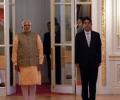
Narendra Modi and his government should look at the emerging geo-politics realistically and not get sucked into having to make a choice between China and Japan. India has enough economic space for both, says Mohan Guruswamy.

Special 301 Report expresses concern over weak IPR laws, to conduct reviews.

'Demchock and Chumar are important crucibles for both China and India to know about the other. While India 'learns,' she also need to 'teach,' suggests Lieutenant General Anil Chait, one of the Indian Army's most cerebral thinkers, who recently retired as chief of the Integrated Defence Staff.

'While China expressed reservations on the Indian role in the South China Sea, Beijing threw to the winds Indian concerns on Kashmir by announcing $46 billion in investments Pakistan occupied Kashmir,' says Srikanth Kondapalli.

The sector will start making operating profits by 2020.

Once again an Indian prime minister has realised that with Pakistan and China, things will not move as he wishes.


China's state media on Tuesday defended Pakistan's nuclear record, saying it was A Q Khan who was responsible for atomic proliferation which was not backed by the government and argued that any exemption to India for Nuclear Suppliers Group entry should also be given to Pakistan.

India and Japan have a shared interest in countervailing China's hegemonic ambitions in Asia. Although neither has an interest in forming an overt anti-China alliance, Tokyo and New Delhi feel increasingly obligated to work together to find ways to guard against a muscular Beijing's power sliding into arrogance, says Brahma Chellaney.

'Whether it's investments in Kashmir, building naval facilities, or selling top-of-the-range military equipment, Pakistan could well benefit more under Xi's watch.' 'Do Chinese concerns about the 'Islamisation' of Pakistan give it pause about how quickly to move forward with security and economic projects? At the moment the indication is quite the opposite: China is doubling down on its support to Pakistan, partly because of its fears about where the country is headed.'

'If Modi were to be elected, he would be part of a coalition government, and within that he would have to take this minority into account. Muslims cannot relate to the idea of Hindu nationalism. Although it is presented as a pan-Indian idea, it appears to them to be exclusive.'

India is no longer shying away from playing a role on the regional and international stages and is willing to don a bigger role in regional politics. It is showing traits of a responsible stakeholder in the regional security dynamics, says Dr Rahul Mishra.

Modi's visit to some developed countries such as the US, Japan, China and Australia were sprinkled with humongous investment figures. But do we have the wherewithal to absorb such big investments?

Voices from the Treasury are clamouring for lowering rates as this would boost demand.

'If India and China come together, 40 per cent of the world's people are going to be prosperous'

For the past few years the top brass at Pearson did pretty well to grapple with the threat of digital disruption.

Following is the full text of Prime Minister Manmohan Singh's speech at the Central Party School in Beijing on Thursday:

PM Modi seems to be gradually ending India's strategic ambiguity

India hopes to bridge gap with US to buffer against a Paris agreement that restricts country's developmental space.

'India's military posture has become significantly stronger than China's on the 3,500-kilometre Line of Actual Control.' 'This is enhancing confrontation between the two sides,' points out Ajai Shukla.

The new national income numbers produced by the Central Statistics Office (CSO) have elicited two kinds of reaction.

It seems China is ready to cooperate with India in the central Asian region through the SCO framework, the reasons for which are manifold, says Sana Hashmi.
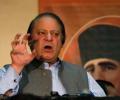
The Sino-Pakistan relationship remains fundamentally asymmetrical: Pakistan wants more out of its ties with China than China is willing to offer. Today, when Pakistan's domestic problems are gargantuan, China would be very cautious in involving itself even more, says Harsh V Pant.

'Modi's promise of change during the election campaign was on the domestic front, but his first year in office focused on foreign policy beyond all expectations,' says Ambassador T P Sreenivasan.

It is well-known, and the Brooks-Bhagat report vouches for it, that the real failure for the 1962 debacle against China was not military, but political, says Ram Madhav.
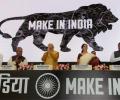
'India is going to maintain its ties to China, India is going to develop a strong relationship with the United States. It means that India is going to have the flexibility to pick and choose its friends.' 'That's traditional Indian foreign policy, and it's smart.' Former US ambassador to India Frank Wisner, one of America's sharpest minds on South Asia, tells Aziz Haniffa/Rediff.com what Washington can expect from Narendra Modi's visit.

'India was in no position to wage another war in 1965, having suffered a morale-shattering defeat in 1962. The three services were in the middle of a modernisation and expansion phase and therefore not fully trained or battle-ready.'

'Soon enough, we were out shouted. The journalist had a multiple agenda -- he berated the Government, the bureaucracy in general and the UPSC system that selected them.'

While China is bigger and feels mightier at the moment, Beijing's rulers would be well advised not to be tempted to provoke India, for that would only trigger a chain reaction around the world that would not serve anyone's interests, says Sanjaya Baru.
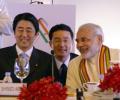
'Both nations have a common problem: A rampaging, jingoistic and hostile China which is making substantial territorial claims. In the long run, Japan and India are going to be the victims of Chinese aggression -- so they might as well hang together to contain China,' argues Rajeev Srinivasan.

Politicians are supposed to get into the business to change the world around them. But it seems Gandhi got into the business to help keep a party running, says Mihir S Sharma

Trade between India and Indonesia stands at $20 billion.
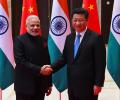
It would be a chance lost if India cannot learn from and lean more on China to kick-start trade, infrastructure programmes, and increased ties, says Ravi Agrawal

China's economy is in transition, with rising wage costs and massive overcapacity.
